CanKata

CanKata

Tuesday, April 23, 2013

CanKata on the West Coast of Sumatra

By Loretta

From  Pulau Weh to Pulau Nias


It has been a while since we had access to internet, so we have a bit of catching up to do. While in Sinabang on Simeulue Island, we had enough internet access to allow us to file our income tax forms but not to upload a blog entry.
 
But we were using our onboard system (run by our HF radio, modem and computer) to keep our families  informed of our whereabouts. I’ll use excerpts from those emails to highlight our adventures in Indonesia.
March 2:
We spent a quiet night on a mooring ball at Rubiah Island and spent most of today motoring in calm seas to Seudu Bay on Sumatra's west coast.
Rubiah Island:
LATITUDE: 05-52.82N
LONGITUDE: 095-15.38E
Sunrise at Rubiah Island.
 
Seudu Bay:
LATITUDE: 05-21.32N
LONGITUDE: 095-14.39E
Seudu Bay
 
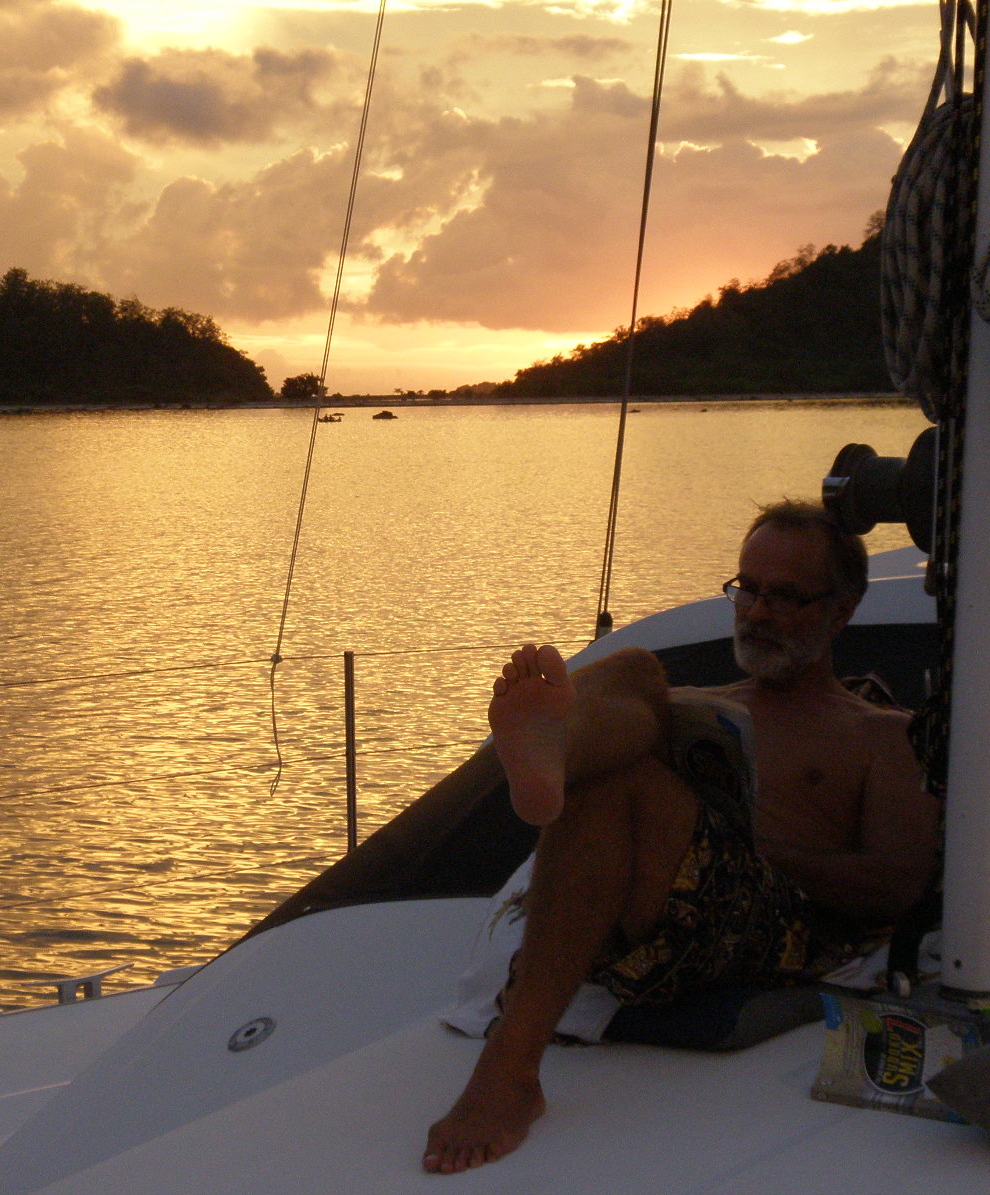
The Captain in Seudu Bay
Relaxing at sunset.
 
The hills seemed to be growing clouds.
 
We were often surrounded by interesting-looking anchovy fishing boats.


March 4:
We motored in calm seas to Tangkura Bay - a remote spot with clear water and interesting fishing platforms.
LATITUDE: 05-07.50N
LONGITUDE: 095-17.91E
 
 
This is the first installment of my "LAST OF" report. Yesterday, we had the LAST OF our fresh garden peas. Maybe "fresh" is an exaggeration, but after soaking them in water in the fridge for an hour, they were pretty presentable. We have many tins of peas to keep us going. And I make a great tinned-pea salad by sprucing them up with a dressing made with mayo and sweet chili sauce and chopped onions.  And our pork?  Ha! We had no pork. We provisioned in Malaysia, land of no pork. We are now in Indonesia, another land of no pork.  But we have plenty of chicken and beef. (We are not in India, land of no beef.) We have never come across a land of no chicken.
 Today we had the last of our cilantro. I will miss it. We are hoping that the markets in future stops will allow us to replenish our peas and herbs. And our diesel. And our Indonesian rupiah.

March 5:
We motored to "Pulau Raya"
LATITUDE: 04-52.86N
LONGITUDE: 095-23.75E

There is a little village here, but the beach is unfriendly - lots of surf and rocks. We didn’t go ashore.
 
 
We had our last orange yesterday, but we have plenty of apples aboard and a good supply of tinned fruit. And we're still hoping to stop at some markets.

March 7:
We had a good overnight sail with a mix of motoring and sailing. The sea was very calm with a gentle 3-foot swell that was well spaced.
My highlight happened during my 8pm-2am watch. I was starting to get a little sleepy so I turned on some lively music. I stood just outside the cockpit to get a look at the Milky Way, and nearly jumped out of my skin when I heard a gasp and splash. I realized right away that it was dolphins playing in our bow wave. It's the first time I've seen them at night (Darrel has previously) and it was amazing to see the bioluminescence glitter as the dolphins glided through the water. Often, three of them would dive out of the water in a synchronized fashion, easily visible by the trail of glitter. I watched in amazement for about 15 minutes, but then the BeeGees came on and the dolphins left - obviously not disco-digging dolphins. One stayed behind a while, dove out of the water a couple of times right beside me, and then zipped off to join its pod.
We anchored in a very deep bay – Sirih Bay on Simeulue Island.
LATITUDE: 02-40.46N
LONGITUDE: 096-09.61E

We had to get quite close to shore to find water shallow enough to anchor in. It is very remote ... not even a mosque in sight. Tomorrow we'll travel another 24 miles to get to a town where we should be able to do some business.
 
The charts in this area are off.
This poor fellow landed on a reef and has been abandoned.
 
March 8:

It took us a while to find a good anchoring spot here in Sinabang (still Simeulue Island) - it's a very deep harbor with a large village.
LATITUDE: 02-28.82N
LONGITUDE: 096-23.16E
 
One of our neighbours.
 
Two local boats had already claimed the one shallower spot we found, but we managed to snuggle safely in between them.
One of those boats had a man on board who saw us, made a phone call, then jumped into his tender, scooted ashore, then returned to us with the Harbor Master, who wanted to come aboard before we had even dropped our anchor. We asked him to wait ("moment please") and he did. Then the two of them came on board, had a drink of iced tea, asked for some beer (we gave them two warm ones) and then the two of them took Darrel ashore to check in.
 
Checking in was smooth and cost about $20 and two more beer, and Darrel saw a few ATMs that we'll try out tomorrow.
Right now several mosques are competing for our attention with their loudspeakers, but I think we'll ignore them all.
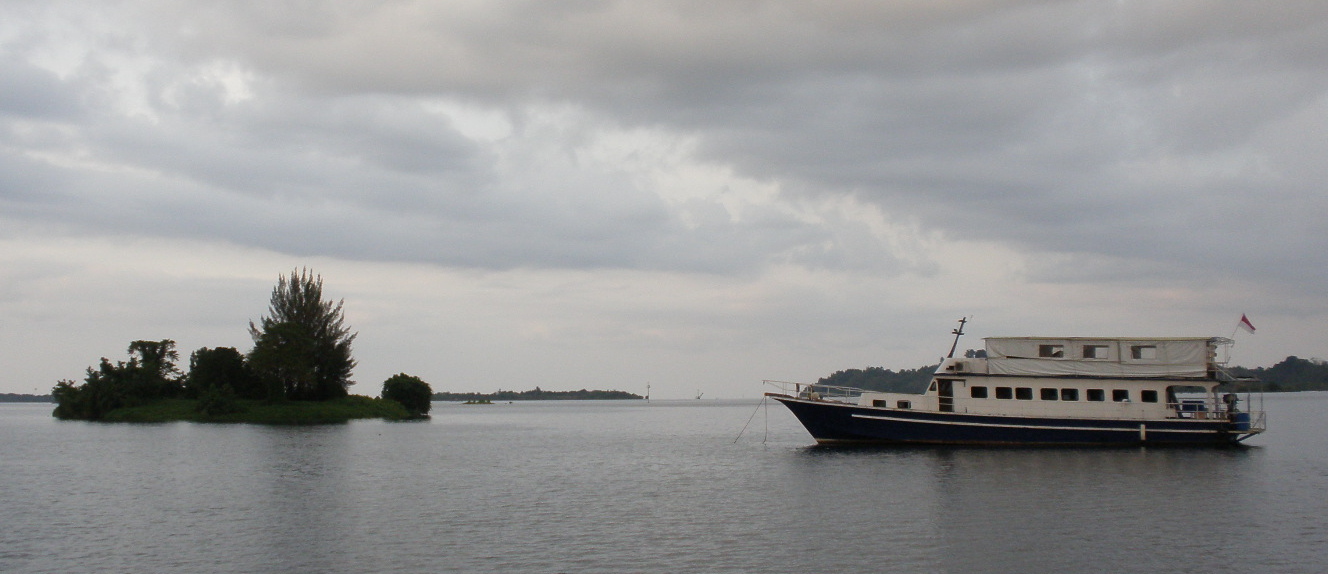
 
Our other neighbour.
We had a very productive couple of days in Sinabang.
Our neighbor, the boat man who helped us with the harbor master, also got our diesel for us in our jerry cans. Not only did he make it very easy for us by loading the cans up in his own tender, delivering them, getting them filled, etc., but he also saved us a pile of money ... to the tune of $120 less than what we would have paid in Sabang for 170 litres. We tipped him well.
Today we finished off our income tax forms and filed them electronically. It took two smoky stops (every man here smokes heavily) - one at an internet place where I used their computer until a bunch of men came in and booted up the other computers and then everything bogged down. So we took our own computer to a coffee shop (where the owner sent his young son down the street to get ice so we could have an iced Milo) and I just managed to finish the electronic filing when a couple of other patrons came in, started up their computers, and then everything bogged down again. Sigh.
 
Darrel kept himself busy taking photos of the village life.
 
"Hello mister!"
 
A unique taxi.
Lots of garbage cans around. And cigarette advertising.
 
Village helpers keep bike seats from getting too hot in the sun by covering them.
We had a couple of good lunches at a local place. Today when we arrived, I was greeted by name. Day two and we're already feeling at home. The cook had to run out and buy a few ingredients for our fried rice. It was delicious. The iced lemon tea was sweet and frosty.


We stocked up on some fresh stuff and I treated us (me) to a bag of chips.
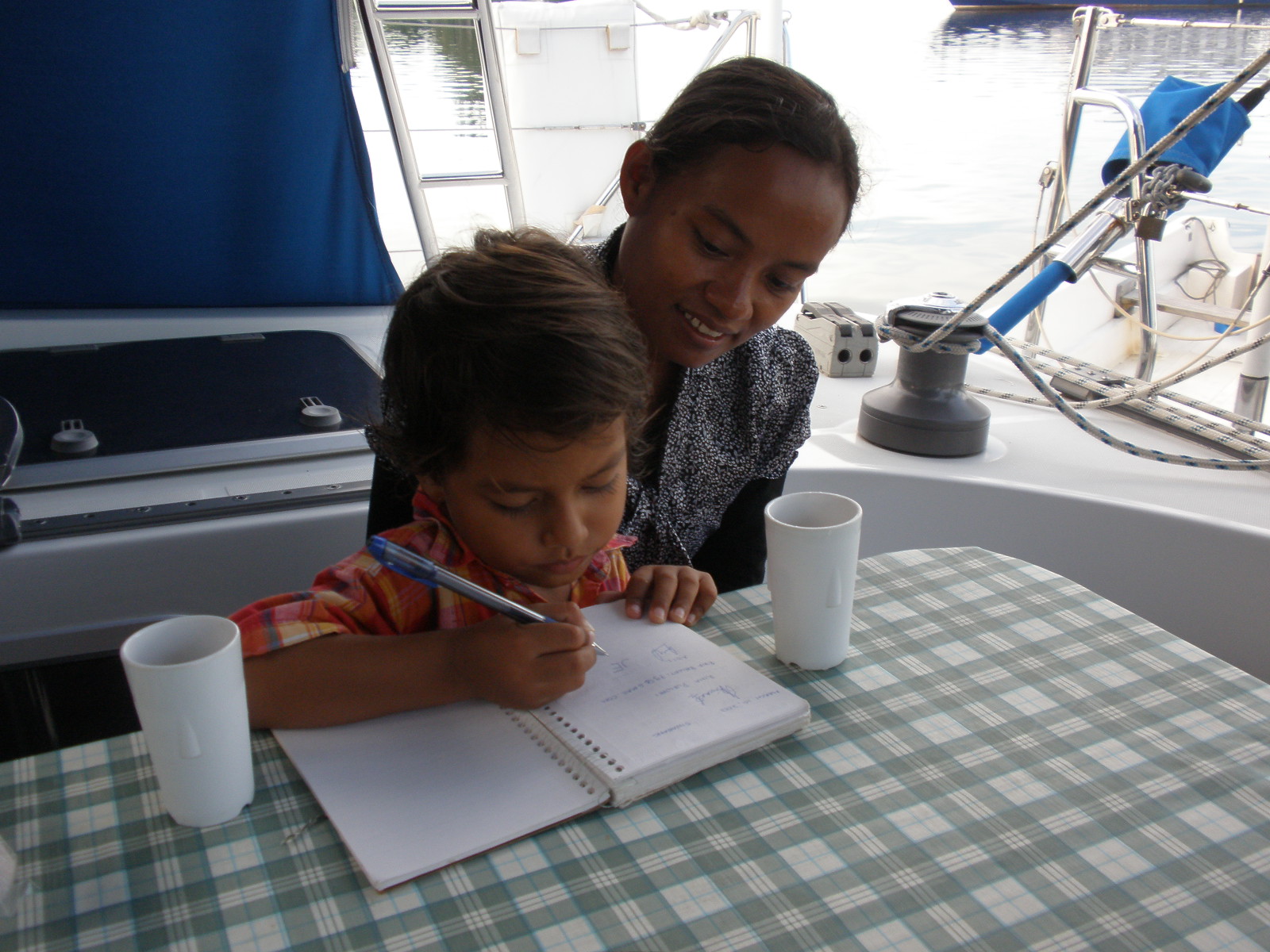
 On our last night in Sinabang, we had visitors aboard CanKata – the operator of the neighboring dive/surf boat – Rina and her son Jesse. Rina, as a tour operator, speaks very good English so we had a nice chat about her life, which has involved much travel and working in places like Singapore and Phuket. Jesse, it appears, is going to be a charmer. Already is, actually.


Sinabang


The wharf at Sinabang

We then took a short trip to Labuhanbajau at the south end of Simeulue Island. We anchored in a lovely bay surrounded by flat land with a gazillion palm trees.
LATITUDE: 02-23.91N
LONGITUDE: 096-23.67E
 We were visited by a delegation of three young boys in a dugout who paddled away smiling and cheering with the treat bag we gave them. A few small fishing boats coasted by and greeted us. There were about ten children on shore, quite close, yelling hello to us and waving madly. They cheered when we waved back. We decided to not go ashore because it was that time of day when the bugs (and kids) start to swarm.


We spent a peaceful night at Labuhanbajau, with fishing boats continuing to pass by and greet us. Sunset was special for the sights but especially for the sound. The mosque chanting was being performed by a sweet, young, haunting voice (maybe a young lad in training?). It gave us goose bumps. While we have tended to tune-out the mosques, we paid particular attention to this one. You could hear a nervous quiver in the lad's voice, but that didn't hide the talent. Unfortunately, he did not perform the 0530 chant the next morning.
We motored to another island under very grey skies and lots of rain. We had some ash on CanKata from our last two stops, so it was good to get a rinse.
We anchored in Pulau Babi on March 12.
LATITUDE: 02-06.89N
LONGITUDE: 096-40.60E
This lovely spot is uninhabited. There is a narrow strip of water along the sandy shore, then a big drop off into 200 feet. We found a good spot to anchor (will probably get some bugs tonight ... on go the screens) and will leave our GPS alarm on in case we get a stiff off-shore breeze. One never knows - the anchor might drag and drop into nothingness.


Sometimes we have to work. We cleaned the cushions here.
Darrel did some waterproofing.
As in most places we anchored, the water was beautiful.
Paradise all to ourselves.
 
We had a productive time in Pulau Babi. We worked hard in the mornings on boat jobs, and then we snorkeled, explored in the dinghy, combed the pristine beach, ate hearty lunches and then spent the late afternoons relaxing.
 It's so quiet here. Darrel said "All I hear is nature".
Again, a few fish boats passed by and waved (nothing for sale, unfortunately). We found it hard to find a reason to leave, other than it was time to move on.
So on March 16 we motor-sailed to a quiet spot in the Banyak Islands - much the same as our last anchorage.
LATITUDE: 02-10.98N
LONGITUDE: 097-11.76E
It's so amazing that there are so many beautiful anchorages in the world with NO ONE in them.
I wanted to say that "all I hear is nature" but right then Darrel was hammering on our refrigerator motor. His repair was successful and our frozen goods are still frozen.
We enjoyed our stay in the Banyak Islands. We had started calling it "boat chore bay". We had fallen behind on our maintenance and, after a couple of good days there, are now caught up. And I'm happy to say that the fridge is running smoothly (knock wood). Darrel sanded the commutator (part of the positive-negative action that runs the motor) and performed some other magic and presto - it purrs!
The snorkelling there was pretty amazing. The water couldn't have been any clearer, and was a perfect temperature. The coral, which seems to be suffering almost everywhere, is starting to come back here. Amazing colors - blue, purple, mauve, green, orange, pink..., and there were a multitude of varieties of colorful reef fish. We saw a couple of rays, but no clown fish or clams.
We had a huge family of baby squid around the boat, and a gazillion minnows. It reminds me of when the loons on Big Rideau Lake used to leave there little ones around our boat when they went fishing. Nice to be considered a safe haven.

March 20
LATITUDE: 02-02.82N
LONGITUDE: 097-07.78E
WHERE: at Pulau Bangkaru in 21 feet
We were told that Pulau Bangkaru was "a good sheltered anchorage in sand" but the sand must have all washed away to Pulau Babi and left coral and rocks. We did find good holding at a muddy little beach beside a mean-looking raised coral bed. The water has some sort of algae growth in this corner, so we won't go swimming. The surroundings are very green and pretty.
 
March 21
LATITUDE: 01-24.26N
LONGITUDE: 097-10.87E
WHERE: at Lahewa Lagoon in 30 feet
We're getting closer to the equator. Funny thing: when we get there, day and night will be equal because of our latitude, at a time when day and night are equal because it is the vernal equinox. Double whammy. Here's the catch, though: while we should be celebrating because daylight is getting longer, for us (after we cross the equator), daylight will be getting shorter. Hmmmmmmm. But as most of you know, this wasn't in the original plan. And it won't be a significant thing.
We had a few stormy days in Lahewa Lagoon with lots of thunder and lightning. Most of our spare electronics spent the time in the microwave oven or the stove's oven. We're still not positive that the stove's oven is a good Faraday cage (we know that the microwave is), protecting our electronics from electrostatic influences, but we're hoping.
It was so very very calm in Lahewa Lagoon. No swell, no waves, no wakes. Other than the few storms, it was so peaceful: the nearby mosques weren't as busy as some are, the songbirds in the lush trees were heavenly, a fisherman played some music that sounded nearly Polynesian, and another fisherman sang some pleasant songs. The skies were full of clouds and electricity, but most of the noise was in the distance, with just a few cracks to keep us
on our toes, and our computers in the ovens. We felt we were a million of miles from anywhere, in a hidden little corner of the lagoon, unable to see the village or harbor.
The tricky entrance to Lahewa Lagoon


A fish farm in the lagoon

We decided to tackle some special jobs that are easier in dead calm, and stayed on CanKata the first day, saving our trip to town for Saturday.

We had a successful trip ashore. There was a sturdy pier to tie up to, then we visited the harbor master (he just got out of bed I think) whom just waved us on and told us to enjoy our visit, and there were several fruit and vegetable stands to allow us to restock, and - thanks to Darrel's keen eye - buy a vegetable we haven't had in a while: avocado! There were a few small stores, too, and we stopped at one for some mosquito coils. There is a cost to pay for lush calmness in water. In the evenings, when watching our movies on the foredeck, we covered up, put on repellent and burned our coils, but still managed to get a few bites. Sigh.

 
Ashore, there were hundreds of school children just getting out of class when we arrived - all neatly attired in their uniforms, some on bicycles, some too shy to greet us, but most eager to try out their English "how are you" on us, and all sweet and having fun. The vendors were helpful and friendly, and we were surprised at the amount of English spoken here. They had lots of questions (where are you from, where are you going, do you have children, etc.) which is just the way it is in the S.E. Asian countries we have been in. It is not impolite to ask personal questions; in fact, it is impolite not to.


A colourful shop in Lahewa


Darrel amongst the school kids.
An iodine wash for the fresh fruit and vegetables
After we got back to CanKata and got into our boat chores, the local coast guard boat pulled up. Aboard was the freshly-showered and fully-awake harbor master, ready to do his job. He was a friendly young fellow, as were the two officers in charge of the boat, and he simply wanted to see our papers and ask us what our business was (and where were we going, do we have any children...). He loved that we are Mr. and Mrs. Smith ("Brad Pitt" - he said, pointing to Darrel). And he hollered at the fellows in the boat, "Mr. and Mrs. Smith!" They all got a good chuckle out of that. I'm wishing that Darrel and I had done some karate kicks on each other to further amuse them, but thought of it too late. We gave them a tour of CanKata, then they left without asking for a fee or cigarettes or beer. The good guys definitely outnumber the bad.
 
We had a good trip today, motoring in calm winds and seas, with me being able to hang my laundry to dry. We will eventually be able to replenish our diesel, so we're not worried about the amount of the motoring we are doing. This is, after all, the doldrums.

 
March 24-26
LATITUDE: 01-15.31N
LONGITUDE: 097-14.41E
WHERE: at Afulu Lagoon in 24 feet
Three hours after we anchored in Afulu Lagoon, we had visitors: a local fisherman who guided us through the reef into the lagoon and who was hoping for a reward (duly given); Kevin, who is on yacht Helena and who lives to surf and who knows lots of great anchorages in these parts; and a local boat with what must have been a family reunion - lots of children, women and men. It was quite a welcome.
 
This was a great stop for us, even though it doesn’t rate highly for beach and water quality. Kevin introduced us to Makmur – a hard-working entrepreneur who helps out cruisers whichever way he can. Here’s what he did for us: got us two SIM cards (so now we can phone fellows like Makmur when we need our SIM cards topped up and now we have internet access - slow!); got us diesel; and – hurray – got us two large yummy lobsters.
An interesting bit of information about Makmur: the Canadian Red Cross rebuilt his home after the 2004 tsunami. They did quite a few homes here. I don’t know who is rebuilding the mosque … Kevin tells us that it’s at the same stage as it was six years ago.
After getting some valuable advice from Kevin on anchorages to the south, we prepared to leave Afulu and our new friend Makmur, looking for more adventures to tell you about.


CanKata Heading to Indonesia

 by Darrel


On our way to Malaysia -
raising anchor at Ko Tarutao

 
After leaving Thailand mid-February we headed to Malaysia to do our last provisioning and to obtain our Indonesian Visas. Once these were completed we raised anchor and pointed the bow towards Indonesia.
 
In order to arrive at daylight in Sabang, which is at the North end of Sumatra, Indonesia, we only sailed the first day as far as the Butang Islands which are out islands of Thailand. We had a great sail there and, with 30 knots of wind blowing on our arrival, we had to sail close in to shore before CanKata was willing to stop for the night.

CanKata at the Butangs
 
The next morning we headed out to sea leaving Malaysia and Thailand behind and had a super sail for the next 20 hours. After that we had to start our engine and motor the rest of the way.

We planned to arrive at Sabang by late afternoon allowing us to rest before clearing into Indonesia.


AIS and Shipping Channel


When we arrived in Malaysia, about 4 years ago, I had the opportunity to take part of a bulk purchase of Automated Identification System (AIS) for shipping receivers. Because it was part of a bulk order the price for the equipment was quite affordable and I thought why not it will make life easier the next time we are sailing in busy shipping areas. Loretta was not all that keen on spending money on the AIS because we had so far managed quite nicely with radar. However, we did buy it and installed it and then never used it – at least until today.

With the AIS receiver we are able to transpose all the ships that are within a 20 mile range of us onto our navigation computer screen. This allows us to easily see where the ships are in relation to CanKata and to determine how far away they are and in what direction and at what speed they are traveling. It also tells us the ships name and what type of vessel they are and what they are carrying etc.

On our second day out from the Butangs, we arrived at the edge of the shipping channel which all the ships take that are traveling between Singapore and the North Indian Ocean and the Red Sea. The channel, which is not really a channel but an area covered by the transiting ships, extends for about 100 miles along the route we were taking.

During the daylight hours we had the odd ship but not anything to worry about. However as it got dark, we really got into the thick of things. For about 6 hours we had about 15 ships within our AIS range. The ships were heading in a variety of directions and at different speeds so we were busy at the helm avoiding them. This can all be done visually with binoculars and radar by determining from their light patterns roughly in what direction they are heading. But with this many ships surrounding CanKata it would have kept the two of us quite busy. With the help of our AIS we were able to keep clear of the ships even when we were caught in the middle of two converging ships.


CanKata is the red boat.
Size not to scale!
 
Following Loretta’s watch she stated that she has converted to being an AIS fan and was very glad to have had it during her watch.
 

We made it safe and sound to Rubiah Island.


Friendly officials greeted us in Sabang

My Favourite Pastime While Making a Passage


During this passage I was reminded what I really liked about cruising. On the day that I wrote this entry, for instance, we had a group of dolphins stop by to say hello and put on a show up at our bow wave. But that is not my favourite activity.

 Having full sails up and sailing along at 6 plus knots and listening to music is a fantastic feeling, but again that is not my favourite pastime.

Watching the sun set and the moon rise simultaneously during a full moon is a beautiful sight, but not my favourite activity.

Watching the star splashed domed ceiling extending from the heavens down to the horizon for a full 360 degrees is a wonderful experience, but still not my favourite pastime.

Perhaps I should have named this entry One of My Favourite Pastimes While Making a Passage.

Because we are on watch 24 hours a day while underway, this means that I have a lot of time to myself and I need something to do to keep me awake. During this time is when I read. We both have Kindles now and a large collection of books to choose from. The Kindle, as with most E-readers, has a built-in dictionary so when I come across a word that I am not sure of the meaning I simply put my finger on the word and up comes the definition.

The book that I am currently reading has a number of unfamiliar words, e.g. , castellated (ouch), métier, and jongleur. Last night I came across the word “unshriven” (for those of you, like me, who have never studied Catholicism or have gone to confession (but perhaps should have). I thought I would try to increase my intellect and look up unshriven in the dictionary. So I placed my finger on the word and up popped the definition:

          unshriven – not shriven

This did not seem to help me out much so I persisted and put my finger on “shriven” and up popped the definition:

          shriven – past participle of SHRIVE

Well I still don’t feel any more intelligent so I once more followed up by placing my index digit, i.e. finger on “shrive” and waited in awe for the definition to pop up. I must confess that I still don’t feel any more intelligent but I still enjoy reading to pass the time while on watch.


Tuesday, February 12, 2013

CanKata is on the Move


By Darrel

Picking the right route, the right anchorages, and the right time.

 
Wow, 4 years have gone by since we sailed (okay motor-sailed) into South East Asia. This is incredible, especially since we had only planned on being in Malaysia for 1 month and Thailand for 1 month. Thailand - what a beautiful place and the Thais are the most beautiful people we have come across in our travels. Thailand is a hard place to leave, but knowing we will be returning here by 2018 makes it somewhat easier.

Some of our beautiful friends from Nai Yang, Phuket, Thailand
 
More beautiful friends from Nai Yang.

We left Nai Yang, which is located at the North West end of Phuket, Thailand at 0830 on February 7, 2013. Since this will be our home upon our return we thought it should be the official start and end of our circumnavigation.

Cankata feeling at home - sunset at Nai Yang.
Photo by Ley of Crystal Blues
 

We plan to spend about 5 years to complete this circumnavigation with the following rough schedule:

2013 - Leave Phuket, Thailand and sail to Cape Town, South Africa (approximately 6800 nautical miles)

2014 – Leave South Africa and sail to St. Martin, West Indies in the Caribbean (approximately 6900 nautical miles)

2015 – Leave the West Indies and sail across the Caribbean Sea to Panama and pass through the Panama Canal into the South Pacific (approximately 2400 nautical miles)

2016 – Leave Panama and sail to Papua New Guinea, Philippians, or Micronesia (approximately 9400 nautical miles)

2017 – Leave where ever we are (as long as it is where we are supposed to be) and sail home, i.e., to Nai Yang, Phuket (approximately 2500 nautical miles)

I may as well tell you before you hear it from Loretta. The reason we have to be back to Phuket by 2018 is because that is when my Thai Driver’s License expires. Or is it really because that is as long as I can go without a massage?


Preparing CanKata for our Voyage

 Since making our decision to continue or restart our circumnavigation last June, we have been quite busy preparing for the months and years ahead. Even though we have continuously kept CanKata well maintained there were some items that we did not have to tend to since we were not venturing out far from land and nearby shops and services. However, knowing that we will be out there with no chandleries or mechanics nearby, we knew that we would have to have CanKata completely operational and have on board a variety of parts and equipment that we could use to repair or jury-rig whatever will break. As Captain Ron said “If it’s going to happen, it’s going to happen out there.”

Our trampolines were reinforced and restrung.
 
The man-overboard pole with new cover.

Safety Items:

Our EPIRB (emergency beacon which automatically sends out a signal identifying our position and to notify coast guard of an emergency on CanKata) was still working but the battery was past its expiration date so we had to get a new battery and have the unit tested and recertified.  

The EPIRB, handy for testing and in case of emergency.
 

We had more flares than required by Canadian and USA Coast Guard but again some of them had reached their expiration date so they were replaced.

Our standing rigging is now 6+ years so it was time to hire a professional rigging inspector to determine if everything is okay. After a very thorough inspection, the inspector informed us that it is quite evident that CanKata is a very well maintained yacht. He did however find a few minor recommendations that we have since corrected.

Our Personal Flotation Devices undergo an inspection every 3 months, but one item we had put off replacing, since we were not doing any night passages, was an emergency strobe light that automatically goes off when submersed in water. So that was replaced.

Our Ditch Kit was emptied when we arrived in S. E. Asia (well at least the consumables e.g. Snickers, Kit Kats, water and hard candies so these items have been replaced.

Navigation Equipment:

Our Radar had been acting up since our mast was taken down a couple of years ago and we knew it was a damaged connector problem. We have now replaced the connector and it works as good as new again.

The screen on our chart plotter had deteriorated to the point we could not view the screen from the helm station so we replaced it with a new one. (Thanks Marleen and Larry for bringing it with you.)

Our new Garmin at the back of the "nav station".
Radar on left, SSB on right. Newest Toshiba laptop performing well.
 
Our Single Sideband (SSB) radio was having trouble getting connected through our modem which is our only means to order a pizza (oh and also to get weather reports and communicate to the outside world). So we hired the experts and after removing all of our SSB components, they were able to detect and solve the problem. “Test Test … I would like to order a pizza with half and half – one half, medium with pepperoni and green peppers, and the other half, large with ham and pineapple.”

Mechanical Equipment:

 Since all of CanKata’s mechanical equipment is needed for coastal cruising, everything has been maintained and kept in proper working order. However, since we will not have the luxury of a nearby chandlery, we had to revisit our spare parts department. Although we are still quite well off with spare parts (some of which we bought even before leaving Canada in 2004), there were some items that we felt we should add, e.g., starter motor, refrigeration motor brushes, water exhaust ends, oil, filters, sea water pump, 12 volt inverters, and belts.

The bilge is a handy place for spare parts.
 
And bilges are handy for tinned drinks too.


General Equipment:

Since we gave up on fishing here about two years ago, we had to purchase additional fishing lures, lines, etc.

We won’t be able to rely on our local laundry ladies so even though our Duo Tub washing machine was still working well, we thought we should replace it with a new one which will hopefully last for the next five years.


Provisions:

Wow are we going to miss Thailand and the Thai meals. Not that Loretta can’t cook a great meal. Whew, good comeback Darrel.

Does anyone know how many tubes of toothpaste, or number of rolls of toilet paper, or cans of tuna, corn, fruit, pop, or bags of sugar, oatmeal, pancake mix, flour, salt, or boxes of UHT milk, orange juice, tea, toothpicks, or jars of jam, syrup, honey, mustard, olives, etc. we will need to provision for our trip to Mauritius or to South Africa? Yikes, neither do we. What we do know is how easy it is to spend lots of money and have a receipt that is about 48 inches in length.  Trust me we will not starve to death.  But we will still miss our wonderful Thai meals.

A cockpit full of provisions.
 
Shirt off, making headway.

Plastic tubs helped with the organization.


Still room in this berth for more provisions ...
but not for visitors.

A very long grocery list ... all in Thai.

Health Care Items:

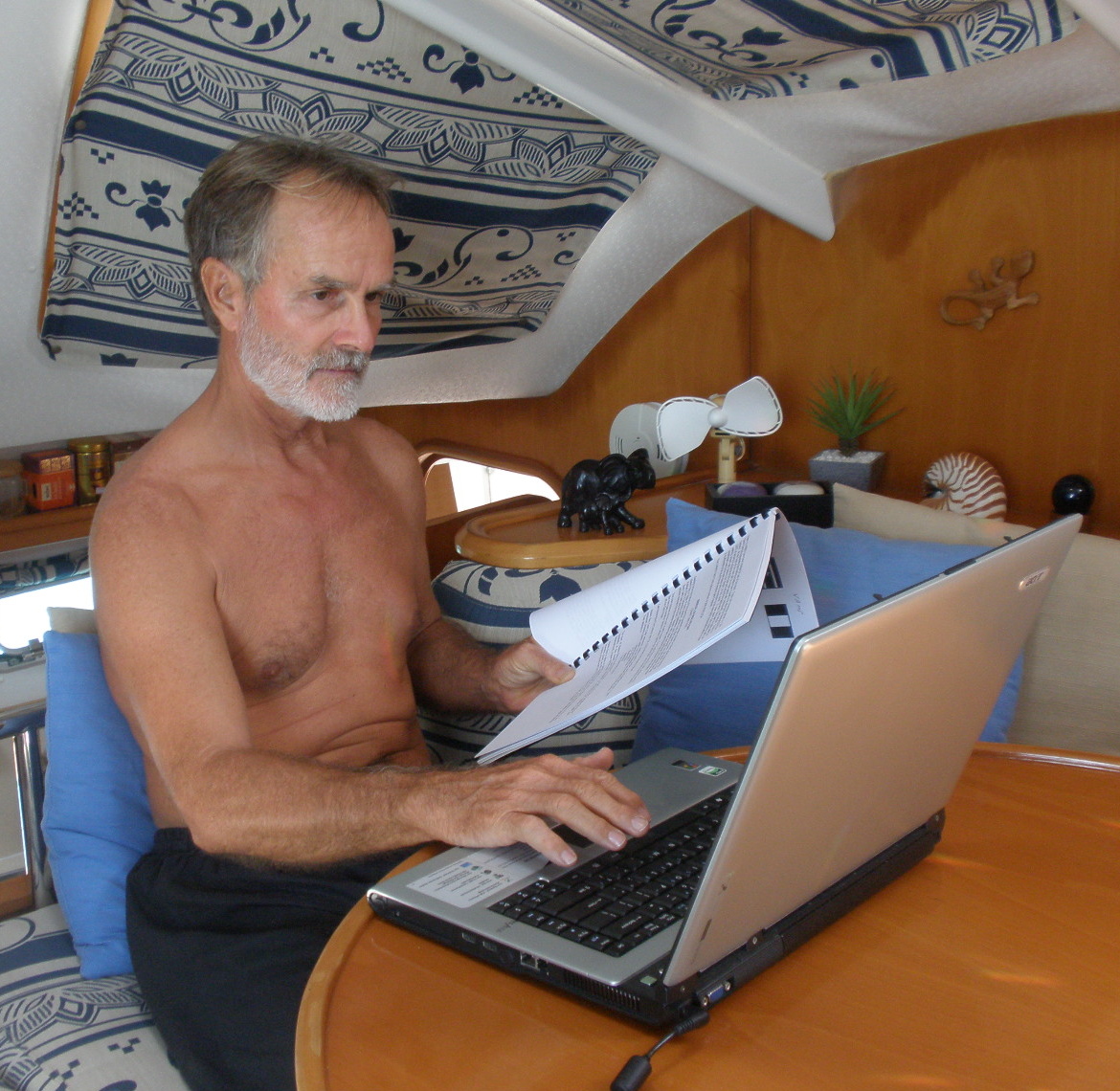
I gave it my best shot. I told Loretta that our massages were an important form of preventative health care and that we should include in our medical kit a young beautiful Thai lady. Unfortunately she did not buy into it. Oh well only five years until my next massage. Yikes – I just got a pain in my lower back.

We had to stock up on all our meds, (not including alcohol) such as antibacterial creams, pills for heart attacks – or more precisely to stop heart attacks, ear drops, antibiotics, etc.
 
.....................................................................

Well we are still floating and with one or two more stops along the way for fuel and more food we should be self-sustaining for many months to come.


Sunday, February 3, 2013

Update on our plans


-      We will see Langkawi again, in just a few weeks! We need a visa to travel the west coast of Sumatra, Indonesia, and the most convenient place for us to get our visas is Penang, Malaysia. So we will sail to Langkawi, Malaysia and then decide how to get to Penang, with our options being sailing, flying, or taking a ferry.

-      Our ham radio is now working as it should. Our voice communications are being heard “loud and clear”, we are receiving well, and our on-boat email system (Winlink) is working like a charm. Thank you to Phuket Marine Electronic Centre for the professional assistance, and to Rolf of SY Ketoro for the recommendation.

-      Here’s a rough idea of our upcoming schedule:

-      February 7: leave Nai yang for Chalong

-      February 12: leave Chalong for Langkawi, Malaysia

-      February 19: leave Langkawi for Penang, Malaysia

-      February 26: leave Penang for Sumatra, Indonesia

-      May 1: leave Sumatra, Indonesia with a few stops before Mauritius

-      June 28: fly out of Mauritius to Canada!!